
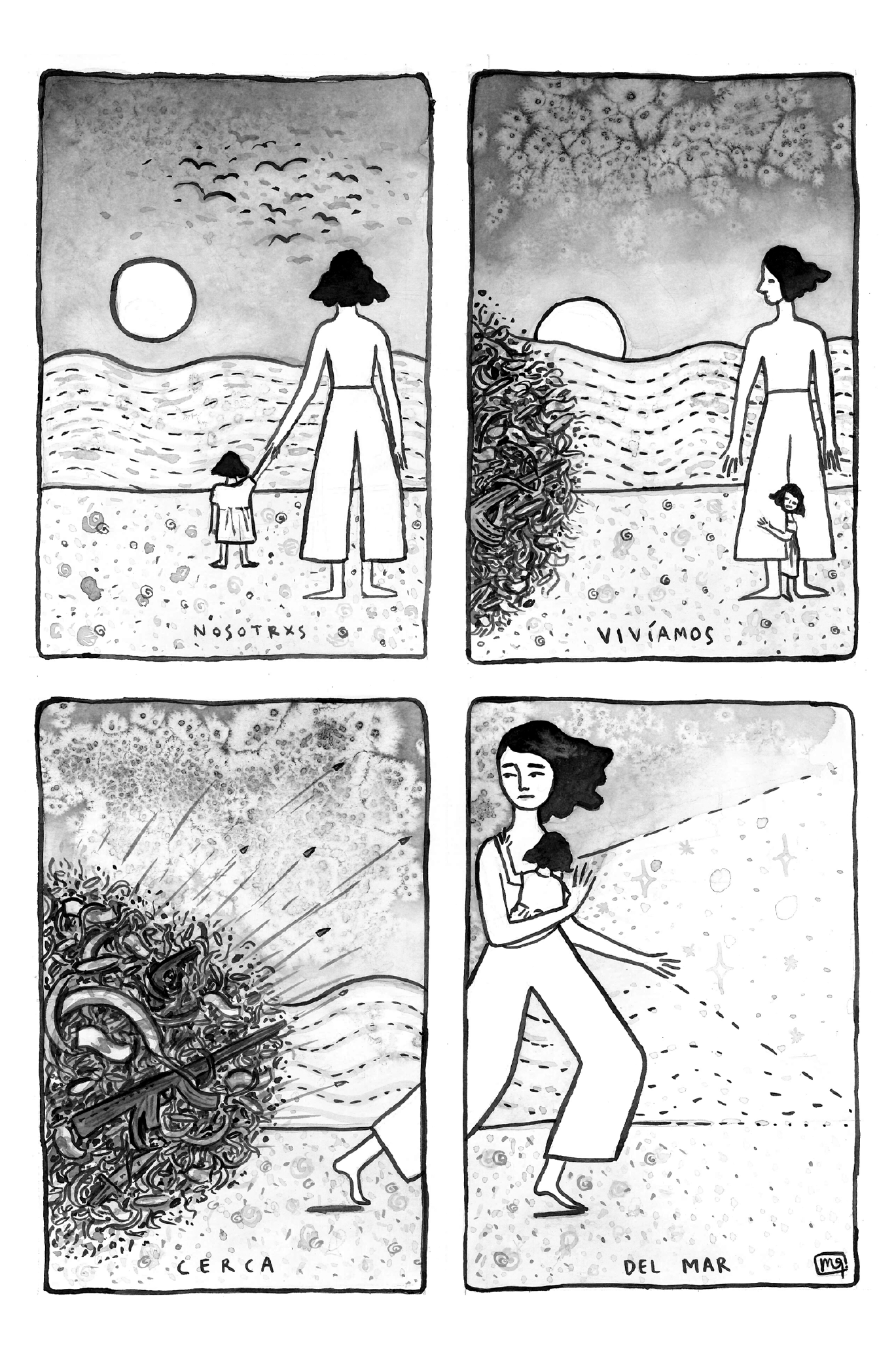
Nosotros vivíamos cerca del mar
Ilustración y dispositivo de mediación artística
Esta ilustración fue realizada como parte del proyecto Procesos de Paz, un espacio de formación impulsado por el Centro Cultural El Carmen de CONECULTA para reflexionar sobre la transformación de conflictos y la construcción de paz desde una perspectiva comunitaria.
La imagen acompaña el relato Nosotros vivíamos cerca del mar, incluido en el libro Esporas, una recopilación de testimonios de mujeres migrantes coordinada por Edgar Núñez. Sin embargo, durante el taller la ilustración no se presentó como acompañamiento del texto, sino como el punto de partida de una experiencia de sensibilización.
La propuesta consistió en invertir el proceso habitual de la ilustración editorial. En lugar de leer primero el relato para después observar una imagen, las personas participantes se encontraron únicamente con la ilustración, sin contexto alguno. A partir de ella fueron invitadas a observar con detenimiento, registrar las emociones, sensaciones corporales e imágenes que aparecían, e imaginar la historia detrás de la escena.
Solo después de compartir algunas de esas narraciones colectivamente se escuchó el relato original en formato de audio.
Este cambio de orden tenía una intención pedagógica muy específica: abrir primero un espacio para la percepción, la imaginación y la empatía antes de ofrecer información o categorías conceptuales. En lugar de preguntar "¿qué entiendes?", la invitación fue "¿qué sientes?", "¿qué historia emerge en ti?" y "¿desde dónde estás mirando esta imagen?".
La experiencia permitió reconocer que una misma imagen puede activar recuerdos, imaginarios y lecturas profundamente distintas, y que esas diferencias también forman parte de la manera en que construimos significado. Al escuchar posteriormente el testimonio real, muchas personas encontraron coincidencias inesperadas con los relatos que habían escrito, mientras otras descubrieron los límites de sus propias interpretaciones y los prejuicios desde los cuales habían observado la imagen.
Desde la mediación artística, la ilustración dejó de ser únicamente un producto visual para convertirse en un dispositivo de encuentro. La narrativa gráfica funcionó como un lenguaje capaz de abrir conversaciones sobre migración forzada, violencia, memoria, pérdida, esperanza y construcción de paz sin comenzar desde la explicación teórica, sino desde la experiencia sensible.
Posteriormente, la reflexión colectiva sirvió como puente para introducir conceptos relacionados con la cultura de paz, las violencias directa, estructural y cultural, así como el papel de las emociones, el cuerpo y la escucha en los procesos de transformación de conflictos.
Esta pieza forma parte de una investigación personal sobre las posibilidades del diseño editorial, la narrativa gráfica y la mediación artística como herramientas para la educación, la construcción de comunidad y la transformación social.
We Used to Live Near the Sea
Illustration as a Tool for Artistic Mediation
This illustration was created as part of Peace Processes, a community-based educational program organized by Centro Cultural El Carmen by CONECULTA to explore conflict transformation and peacebuilding through dialogue, creativity, and collective reflection.The image accompanies We Used to Live Near the Sea, a testimony included in Esporas, a collection of stories by migrant women compiled by Edgar Núñez. During the workshop, however, the illustration was not presented as a companion to the text. Instead, it became the starting point of a process of artistic mediation.The exercise intentionally reversed the traditional relationship between text and image. Rather than reading the story first and then looking at its illustration, participants encountered only the image, without any contextual information. They were invited to observe it carefully, notice the emotions, bodily sensations, memories, and associations that emerged, and imagine the narrative behind the scene.Only after sharing some of these texts in a group circle did participants listen to the original testimony through an audio recording.This inversion served a pedagogical purpose: to create space for perception, imagination, and empathy before introducing factual information or theoretical concepts. Instead of asking, "What do you understand?", participants were first invited to ask themselves: "What do I feel?", "What story is emerging within me?", and "From what perspective am I looking at this image?"The experience revealed how a single image can evoke profoundly different interpretations, memories, and emotional responses. These differences became an opportunity to reflect on the ways we construct meaning and how our personal experiences, assumptions, and cultural frameworks shape our understanding of others. Listening to the original testimony afterward allowed participants to recognize unexpected parallels with their own writings while also confronting the limits of their initial interpretations.From the perspective of artistic mediation, the illustration ceased to function merely as a visual representation and instead became a relational device—a space for dialogue. Graphic storytelling became a language through which participants could approach migration, violence, memory, loss, hope, and peacebuilding without beginning from abstract theory, but through lived, embodied experience.The collective reflection that followed served as a bridge toward concepts such as direct, structural, and cultural violence, peace culture, emotional awareness, embodiment, and the role of attentive listening in conflict transformation.This work is part of my ongoing research into the potential of editorial design, illustration, graphic storytelling, and artistic mediation as tools for education, community building, and social transformation.Ultimately, the exercise was not about interpreting an image correctly. It was about discovering how every act of looking is also an act of projection, and how empathy begins when we recognize that our first interpretation is never the only possible one.